

1-Introductionm
Understanding Frequency Analysis and Aliasing in Computer Vision
Why Frequency Analysis Matters in Computer Vision
Alright, this is where things start to come together.
If you’ve been following along with frequency analysis in computer vision, you’ve probably noticed—it can feel a bit abstract. A lot of math, a lot of theory, and not always obvious how it connects to real image processing tasks.
But here’s the thing: frequency analysis is essential. And in this post, we’ll connect it to something practical—aliasing in images.
Quick Recap: Fourier Transform and Frequency Domain
In computer vision, we often represent images not just in terms of pixels (spatial domain), but also in terms of frequencies.
Using the Fourier Transform, we can break down an image into sinusoidal components—basically, waves of different frequencies.
Think of it like this:
- Low frequencies → smooth variations (like lighting)
- High frequencies → sharp edges and details
We’ve been working with Fourier basis functions, which let us express images as combinations of sine and cosine waves.
Convolution vs Multiplication: A Key Relationship
One of the most important ideas in frequency analysis is this:
Convolution in spatial domain = Multiplication in frequency domain
In simple terms:
- If you blur or filter an image (convolution),
- You’re actually multiplying frequencies behind the scenes.
And the Reverse is Also True
Multiplication in spatial domain = Convolution in frequency domain
This might sound less familiar, but it becomes important when working with special functions (like masks or sampling patterns).
And yes—this is exactly where aliasing starts to show up.
Fourier Pairs You Should Know
Some common transformations come up again and again in computer vision:
- Gaussian → Gaussian
A Gaussian function stays Gaussian in frequency space. - Impulse → Constant (flat spectrum)
A spike in space spreads across all frequencies. - Box filter → Sinc function
This explains ringing artifacts in images.
These relationships help explain why certain filters behave the way they do.
What Is Aliasing (And Why It Happens)
Aliasing happens when an image is sampled too coarsely.
In frequency terms:
- High-frequency details get misinterpreted as lower frequencies
- This creates distortions like jagged edges or moiré patterns
So instead of clean detail, you get artifacts.
👉 This is why frequency analysis matters—it explains why aliasing occurs, not just what it looks like.
All right, welcome back to Computer Vision. This is going to be our last lecture or lesson or whatever this is on frequency analysis. And I bet you're happy about that because it's kind of off in the ozone of mathematics and it's going to, hard to pull it back to the work that we'll be doing in terms of manipulating the images. But it's important and in fact today we'll finally get to the, what is coup de grace, piece de resistance my, my french is terrible. The fine, what I really wanted to get to is the notion of how frequency explains the notion of aliasing. So if you remember we've been talking about Fourier basis sets where we decompose things in terms of sinusoidal basis. And this is a picture that we've been using to represent that. And then we talked about the relationship between convolution in the spacial domain giving you multiplication in the frequency domain. And we showed it with the math here.

We said that if g was the convolution of some functions f and h, that we could derive that convolution in the spacial domain was multiplication in the frequency domain.
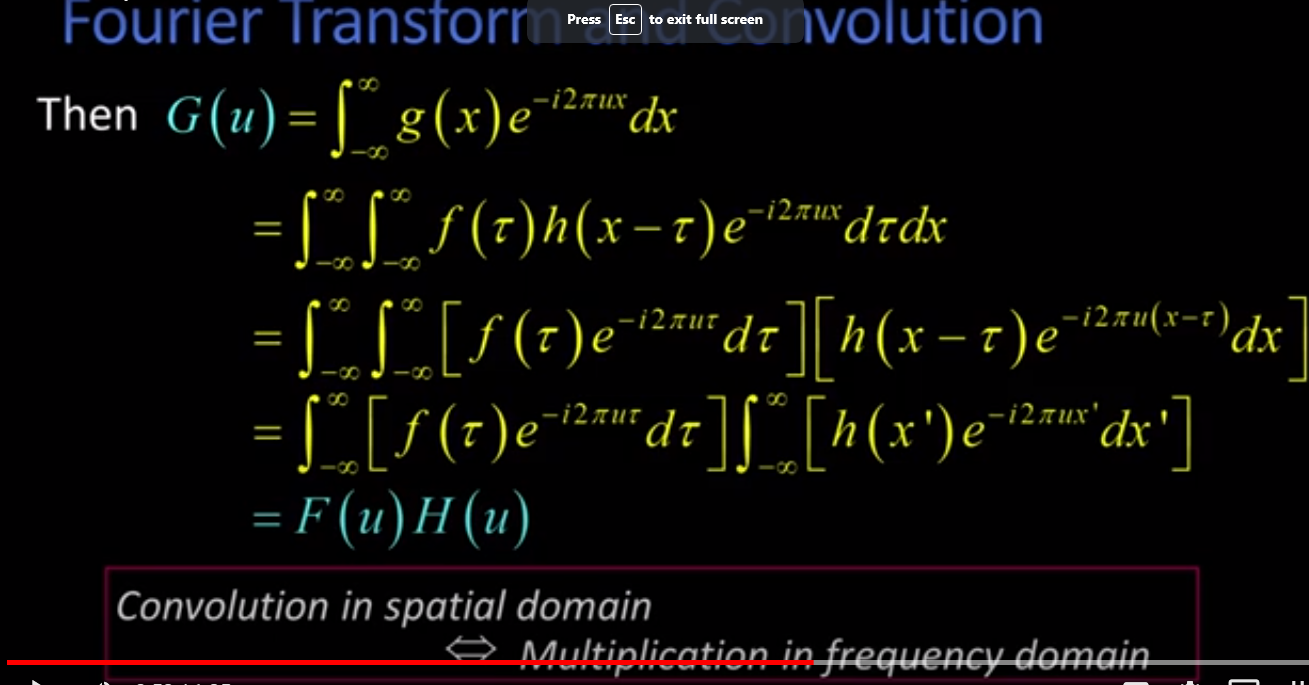
And that was shown like this. And, by the way, then this is really important for today that multiplication in the spacial domain is convolution in the frequency domain.
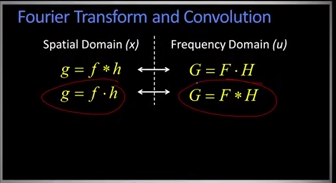
And you might ask, when do we ever multiply functions together. >> When do ever multiply functions together? >> Today. It'll be some very special functions, but we'll do that today.
We also showed some Fourier pairs. We talked about how the Fourier of a Gaussian is a another Gaussian. We talked about an impulse is straight. We spoke about the box filter giving you this sink thing that explained ringing in that like.