

2-Multivariate chain rule
In the last module, we saw something called the Total Derivative. Which showed us that when we have a multi-variable function such as f of x,y, and z but the variables x,y, and z within themselves, each of function of some additional variable t.
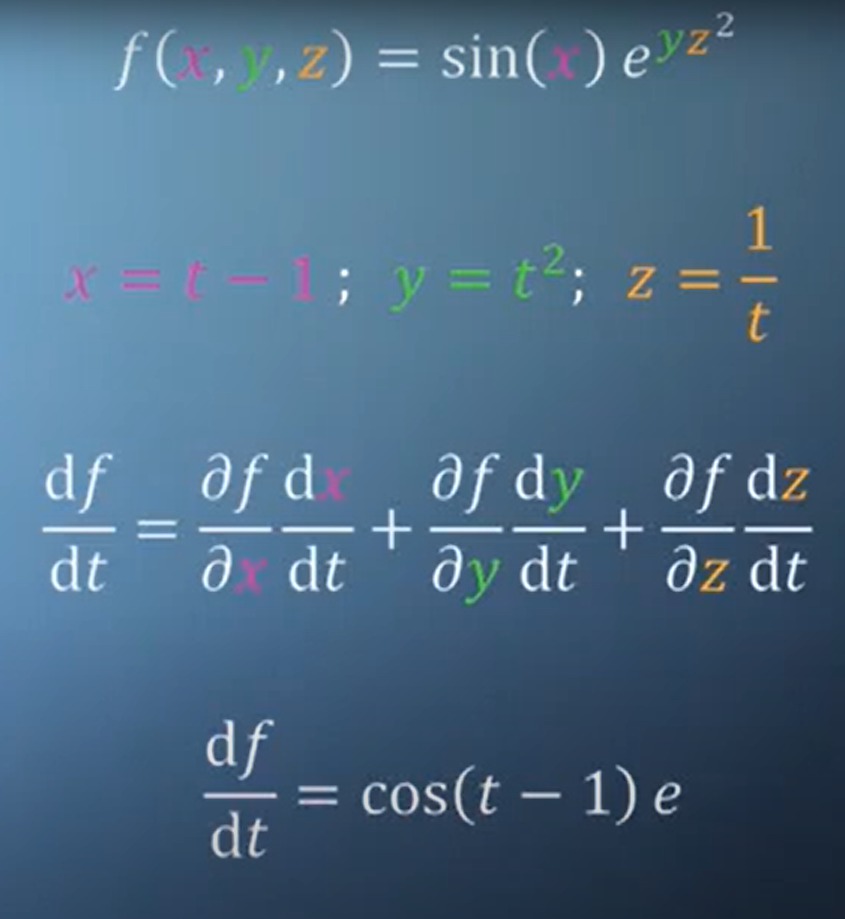
Then, if we want to calculate the derivative of f with respect to t, we can use this expression which is simply the sum of the chains relating f to t through each of its three variables. This allowed us to calculate the result in a Piecewise manner rather than substituting everything in at the start. And computers are really good at solving Piecewise problems quickly.


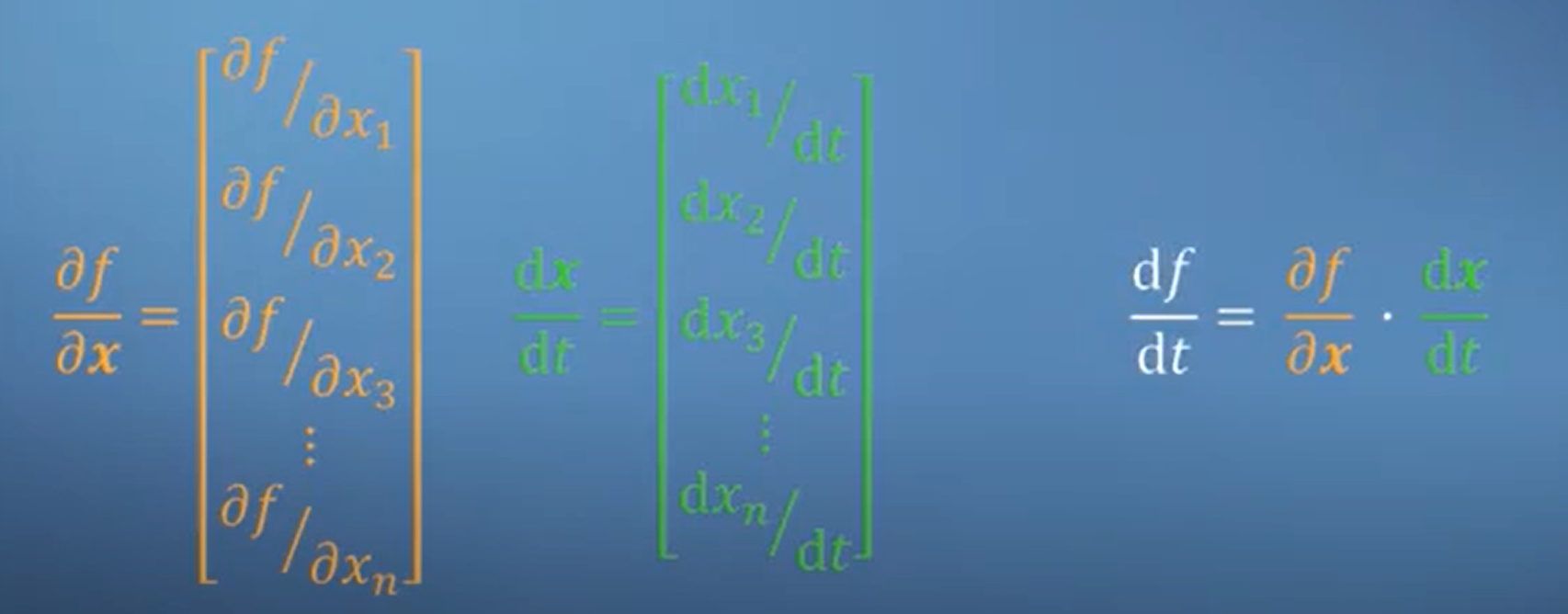
What we're now going to do is generalize this concept and also simplify the notation a little. If we had a function f of n variables x1, x2, x3 all the way up to xn. I can write this as just f of x but now, you'll notice that I've written that x in bold. Just to help you remember that this x represents a sequence of variables which will now more conveniently think of as an n-dimensional vector. Once again, each of the components of our x vector are themselves functions of some other variable t, and what we'd like to know is, the derivative of f with respect to t. At this point we're going to need some more space to write. So, we'll keep our function f at the top, but you'll just have to remember that each component of x is also a function of t. Now we are looking to once again build an expression linking f to t through the sum of the chains of each of its variables. So, we're going to need all the partial derivatives of f with respect to x, as well as the derivatives of each component of x with respect to t. Once again, we're going to store all of these objects in a pair of n-dimensional vectors. Finally, we are looking to build a multi-variable chain rule expression. So, we are looking to find the sum of the product of each pair of terms in the same position in each vector. Thinking back to our linear algebra, this is exactly what the dot product does. But there is no need for us to write out these vectors in full so we can simply write the dot of our multi-variable derivative expressions.

And that's it, we now have a generalized form of the multi-variable chain rule expressed nice and neatly, so we can now update our list of tools to reflect this. But actually, although, we've seen this in practice already in the last module it's worth pointing out that all the rest of our time-saving rules already work for multivariate problems as they are. So, we'll be ready to put these into practice very soon. See you then.