14-Variance or Standard Deviation
So the Gaussian we just talked about is what's referred to as isotropic, a fancy word for circularly symmetric. And so it basically had one parameter, just sigma, right? Bigger sigma is, the more the blur. But we have to implement these in digital computers. We actually have to have a matrix, and so then we have to worry about two things. The size of the matrix, is the matrix three by three, five by five, eleven by eleven? And then the sigma that's represented within that.
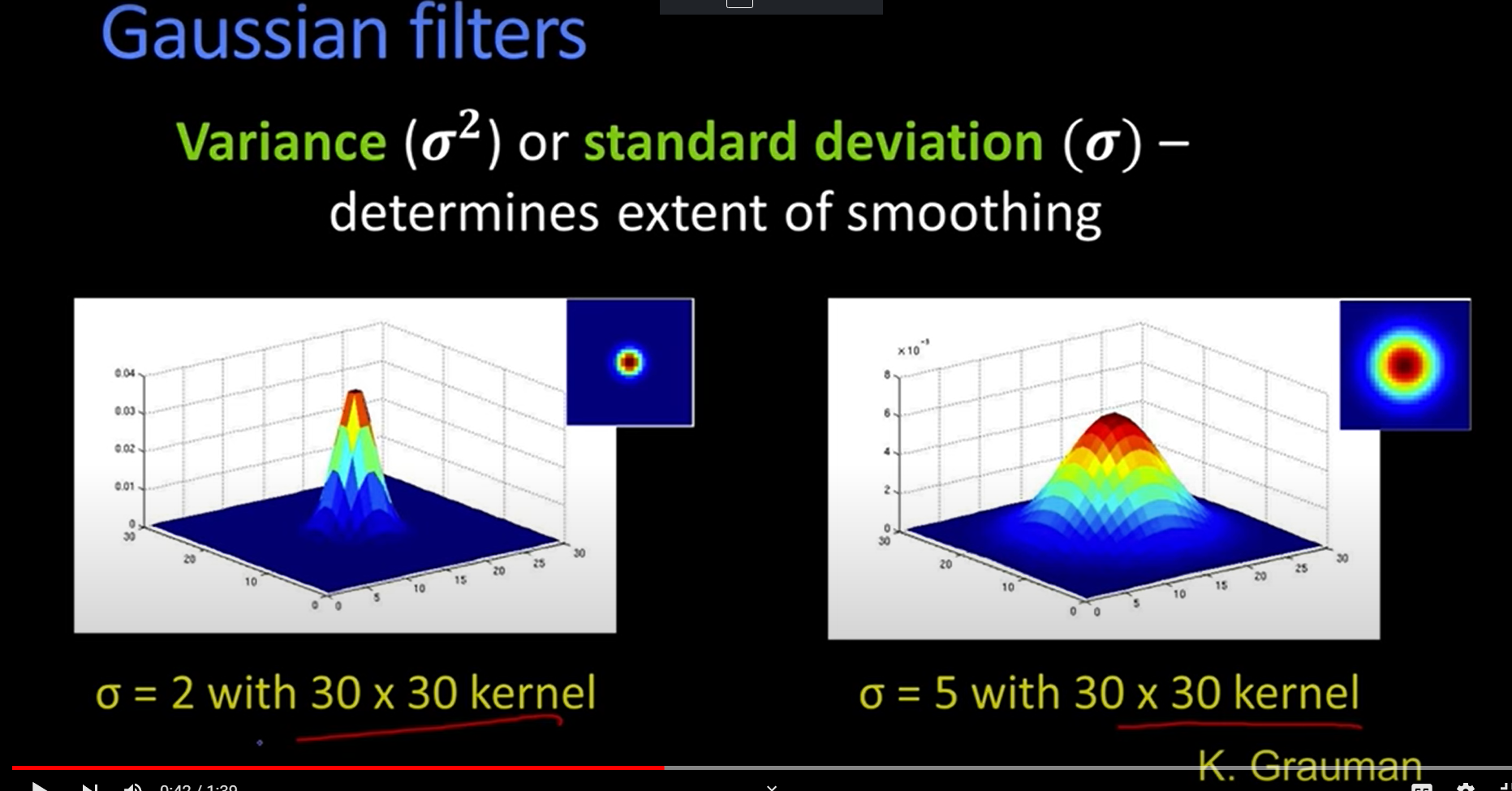
So let me show you that first. In Gaussian filters we talk about the variance, sigma squared of the standard deviation of sigma, and that's the amount of smoothing. So these two filters are the same size, they’re both 30 by 30s, but the sigma inside one of them is two, the sigma inside the other one is five, so the five has a larger sigma. Now sometimes we’ll make a mistake and say it’s a larger kernel. When we say larger, what we actually are talking about is the size of the sigma inside. And we can distinguish that. So here's an example of the size of the kernel. So both of these kernels have a sigma of five, but one of them is represented within a 10 by 10, and the other is represented within a 30 by 30. Which one do you think is going to work better? The bigger one, it's smoother, it's going to work better, okay. And by the way, if somebody says, oh I, I smooth that with a bigger kernel. They actually mean a bigger sigma. That's what you care about, is the size of the sigma, not the actual kernel. The kernel has to be big enough and then the sigma is, is within that.