

5-Weighted Moving Average
Introduction
Computer vision tasks often involve analyzing sequences of images or frames, where noise and fluctuations can obscure important details. This is where weighted moving averages (WMAs) come in, playing a crucial role in smoothing and filtering visual data.
But what exactly are WMAs, and how do they benefit computer vision applications? Let's dive in!
Section 1- Understanding the Average with Weights
Weighted moving averages are an extension of the classic moving average (MA) concept. While a regular MA assigns equal weight to all values in a window, WMAs give specific weights to different data points. This allows us to prioritize recent information or emphasize specific trends within the sequence.
Imagine analyzing object movement in a video. Newer frames likely offer more relevant information about the motion, so assigning them higher weights in the WMA leads to a smoother and more accurate trajectory.
Let's revisit our weighted average. Okay. So, instead of just thinking about averaging the local pixels, let's think of this as a set of weights, okay, and what we're going to do is we're going to weight all of these pixels by some set of weights, and we're going to combine them using those weights to come up with the new value. Now when we were just doing the moving box, our weights were just, let's say it was five long, they would be one fifth, one fifth, one fifth, one fifth, one fifth, five of them, right? So our weights was uniformly distributed, okay.
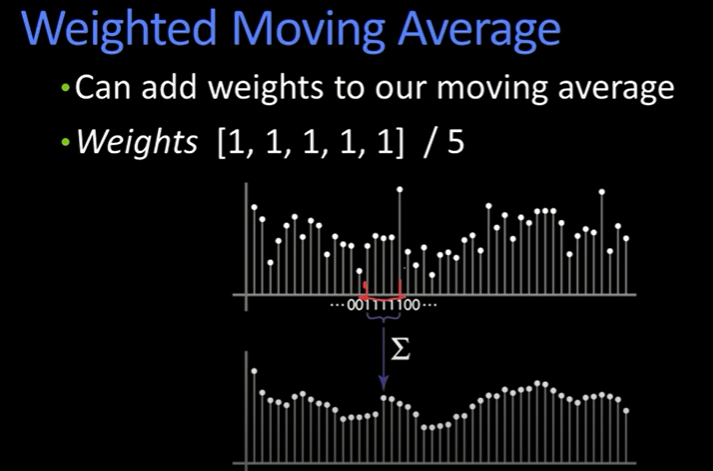
does that make sense? Remember our assumption that nearby pixels are related to my value? And there's another related assumption to that. The more nearby you are, the more related you are. So that means that pixels that are closer to me should contribute more to the average. So let's change our moving average, so that that's true, okay? Before, if you remember, we had these uniform weights. One, one, one, one, one, all the way across, divided by five. What if we wanted to use some nonuniform weights? So, so here's a set. One, four, six, four, one divided by sixteen. And what I’m going to do is I’m going to change those weights from being uniform to being nonuniform, and I want you to watch what happens to this bottom picture. So that’s the uniform weight, and that’s the nonuniform, centered weighted, right. Uniform. Nonuniform. And you'll notice that the nonuniform is a smoother rendition. In fact, you know, take a look here. You know, this area right there, we get a smoother range of, of what's going on. And the nonuniform weights corresponds to this assumption that the more nearby a pixel is, the more weight it should have.

Section 2- Types of Weighting Strategies
Several weighting strategies exist, each with its own advantages:
- Linear weighting: Assigns weights decreasing uniformly towards older data points. Simple and effective for general smoothing.
- Exponential weighting: Recent data receives exponentially higher weights, ideal for tracking rapidly changing information.
- Gaussian weighting: Weights decay according to a bell curve, emphasizing values near the center of the window. Useful for highlighting localized trends.
The choice of weight depends on the specific task and desired outcome.
Section 3-Applications in Computer Vision
WMAs find diverse applications in computer vision, including:
- Motion tracking: Smoothing object trajectories and reducing jitter.
- Background subtraction: Identifying foreground objects by filtering out static background variations.
- Noise reduction: Removing unwanted grain or artifacts from images.
- Object detection: Enhancing object contours and simplifying feature extraction.
- Video stabilization: Compensating for camera shake and creating smoother visuals.
Section 4- Beyond Smoothing: More Advanced Uses
WMAs can also be used in conjunction with other algorithms:
- Combining with Kalman filters: For more robust motion tracking that incorporates system dynamics.
- Weighted median filters: Replacing central pixels with weighted medians of their neighborhood, further reducing noise while preserving details.
Conclusion
Weighted moving averages provide a powerful tool for denoising and smoothing data in computer vision. By strategically assigning weights, we can extract cleaner signals, track objects more accurately, and create visually appealing results. Whether you're working on motion analysis, video stabilization, or object detection, consider leveraging the flexibility and effectiveness of WMAs in your computer vision pipeline!
This blog has just scratched the surface. Further exploration can delve into specific implementations, comparisons with other filtering techniques, and cutting-edge applications in emerging areas like autonomous vehicles and augmented reality. So, keep exploring and let WMAs help you see computer vision data in a clearer, more meaningful light!
For most of us, we tend to use odd sized sets of weights. And what that let's me do is put my set of weights centered over the pixel that I'm changing. All right? Otherwise, what I have to do is sort of put the center between the set of weights and average them that way. And that what, and then, so we tend to use a odd but symmetric weight mask. 