

16-Why This Hard
Look. You opened your eyes sometimes, you know, when you were really, really small. kind of fuzzy for a while. But after a while, you just saw. So you might wonder, you know, why is this hard?
Let me give you a couple of examples. So here we have a, what you think of as a simple scene, and this was generated by Ted Adelson up at MIT. Allright?
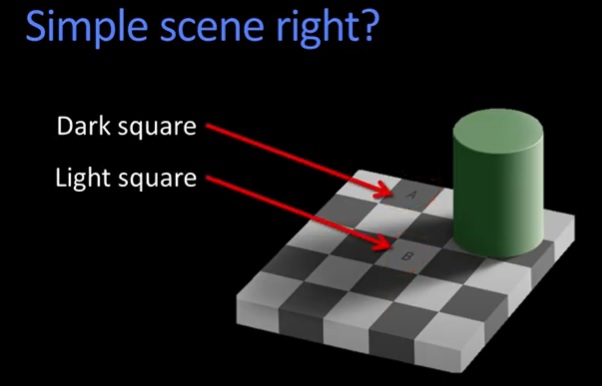
And you see on this screen, we've got this checker board here. And we've got this cylinder casting a shadow. All right? And there are light and dark squares. And you see these two squares, the A square and the B square? Which of those two squares do you think is actually darker? Okay. Well if you're like me you say, well duh, it's the A square. Okay that's, the A is dark, and B is light. Maybe not so fast.
All right?
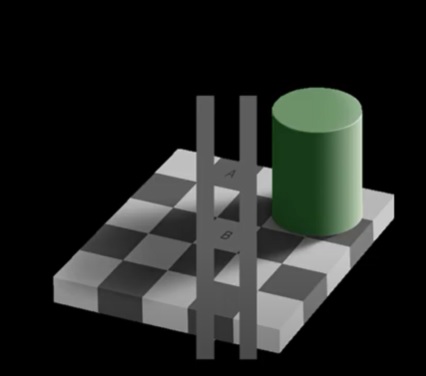
So here I have a gray bar, and this gray bar is the same intensity all the way down. And through the magic of Powerpoint, we're going to slide that grey bar over, and now we have a problem. There's no edge here, there's no edge there. That's a constant grey bar, right? That means squares A and B are actually the same color on this screen. Really. In fact if I put two of those bars there, you start to be able to see it. Let me go back and forth there.
Do you see that? When there is only one bar, your brain just wants you to believe that that is a checkerboard. And that it, the cast shadow, and that's the light square. If you actually took a photometer and you measured it, you would see that are as many photons coming off of this region, as off of that region. But the photometer doesn't have your brain. It doesn't understand. No, no. no, no, that's actually a light square in a cast shadow. All right? This is why computer vision is hard.