Lecture 1: Introduction to Digital Image Processing
What does digital image processing mean?
The first one is processing, then image than digital; so digital image processing means the processing of images that are digital in nature by a digital computer.
Why do we need Digital image processing
So you will find that digital image processing techniques are motivated by two major applications. The first application is the improvement of pictorial information for human perception. So this means that whatever image you get, we want to enhance the quality of the image so that the image will have a better look and it will be much better when you look at the image.
The second important application of digital image processing techniques is for autonomous machine applications. This has various applications in industries particularly for quality control, assembly automation, and many such applications.
And of course, there is a third application which is for efficient storage and transmission, say for example, if we want to store an image on a computer, then this image will need a certain amount of disk space. Now we will look at whether it is possible to process the image using certain image properties so that the disk space required for storing the image will be less; not
that, we can also have applications where we want, where we want to transmit the image or the video signal over a transmission medium. And in that case, if the bandwidth of the transmission medium is very low, we will see that how to process the image or the video so that the image or the video can be transmitted over low bandwidth communication channels.
Human Perception
Now, these methods mainly employ different image processing techniques to enhance the pictorial information for human interpretation and analysis. Typical applications of these kinds of techniques are noise filtering.
Noise filtering
In some cases, the images that you get may be very, very noisy. So we have to filter the images, filter those images so that the noise present in the image can be removed and the image appears much better.
Content enhancement
In some other kinds of applications, we may have to enhance certain characteristics of the image. So the different kind of applications under this category one is the contrast enhancement. So sometimes the image may be very, very poor contrast and we have to enhance the contrast of the image so that it is better visually.
blurring
In some other cases, the image may be blurred. This blurring may occur because of various reasons. Maybe the camera setting is not proper or the lens is not focused properly. So that leads to one kind of blurring. The other kind of blurring can be if we take a picture from a moving platform, say for example from a moving car or from a moving train, in that case, also you might have observed that the image that you get is not a clear image but it is a blurred image. So we will look at whether the image processing techniques can help to rectify those images. The other kind of application is remote sensing. In remote sensing, the types of images that are used are aerial images and in most of cases, the aerial images are taken from a satellite. Now let us look at different examples under these different categories.
Application of Image processing
1- Noise Filtering
Here you find that you have a noisy image, the first image that is shown in this slide is a
noisy image.

and this kind of image is quite common on a TV screen. Now you will find that the digital image processing techniques can be used to filter these images and the filtered image is shown on the right-hand side and you will find that the filtered image looks much better than the noisy image that we have shown on the left side.
2- Content Enhancement
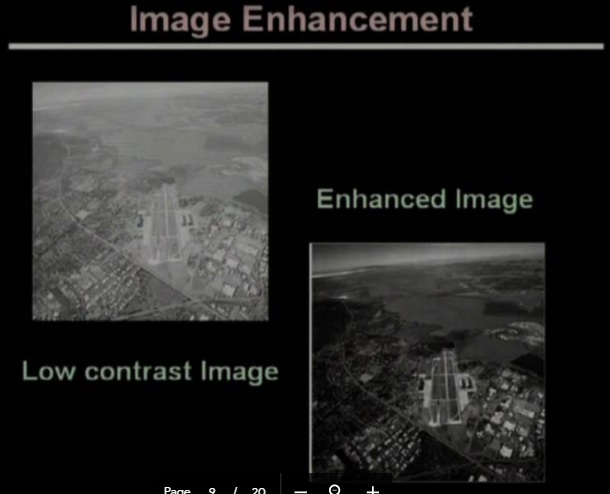
In the second category of image enhancement you will find that again on the left-hand side, we have an image and on the right-hand side, we have the corresponding image which is processed to enhance its contrast. If you compare these two images, you will find that in the low contrast image, in this case, there are many details that are not clearly visible. Say for example the waterline of the river. Simultaneously if you look at the right image which is the processed and enhanced version of the low contrast image you will find that the waterlines of the river are clearly visible. So here after processing, we have got an image that is visually much better than the original ow contrast image.

This is another example of image enhancement. Here on the left-hand side, we have a low contrast image but in this case it's a color image. And I am sure that none of you will like to have a color image of this form. On the other hand, on the right hand side we have the same image which is enhanced by using the digital image processing techniques and you will find that in this case again, the enhanced image is much better than the low contrast image.
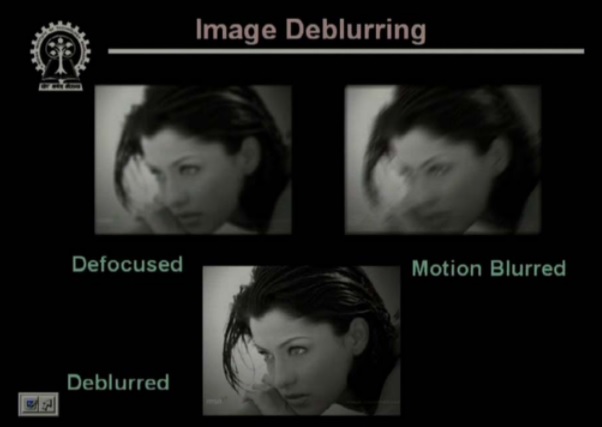
I talked about the other content enhancement where we have said that in some of the applications, in some cases the image may be blurred. So here on the top row, the left side you find an image that is blurred and in this case, the blurring has occurred because of the defocused lens. When the image was taken the lens was not focused properly. And we have talked about another kind of blurring which occurs if you take a picture from a moving platform, may be from a moving train or from a moving car. Since such cases, the type of image that we usually get is the kind of image that we have shown on the right hand side of the top row. And here you find that this kind of blurring is mostly the motion blurring. And the third image on the bottom row, it shows the processed image, whereby processing these different blurred images we have been able to improve the quality of the image.
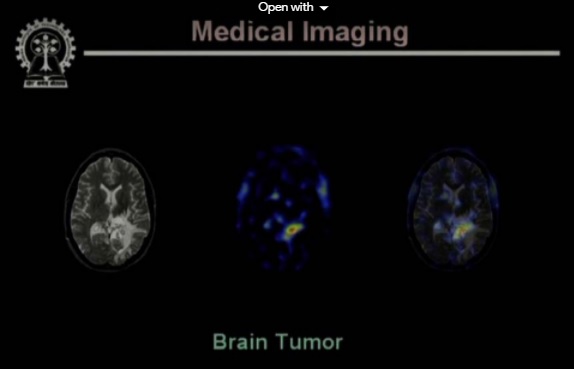
Now another major application of digital image processing techniques is in the area of medicine. I am sure that many of you must have seen the CT Scan images, where the images of the human brain are formed by using the CT scan machines. Here it shows one slice of a CT scan image and the image is used to determine the location of a tumor. So you find the left-hand image is the original CT scan image and the middle and, the image on the right-hand side, they are the processed images. So here, in the processed image, the region of yellow and red, they tell you the presence of the tumor in the brain. Now these kinds of images and the image processing techniques are very, very important in medical applications. Because, by these processing techniques, the doctors can find out the exact location of the tumor, the size of the tumor and many other things which can help the doctor to plan the operation process. And obviously this is very, very important because in many cases it saves our lives.
This is another application of the image processing techniques in the medical field where you have shown some images, some mammogram images which show the presence of cancerous tissues. So this image processing technique in the medical field is very, very helpful to detect the formation of cancers.

This shows another image that is very, very popular and I believe most of you have heard the name of Ultra-sonography. So here we have shown two images, two ultrasonic images which are used to study the growth of a baby while the baby is in the mother's womb. And this also helps the doctor to monitor the health of the baby before the baby is actually born.

3- Remote Sensing
The image processing techniques are also very, very important for remote sensing applications. So here, this is an image, a satellite image which is taken over the region of Kolkata and you find that many of the information which are present in the image. The blue line, the blue thick line, it shows the river Ganges and there are different color coding used for indicating different regions. And when we have a remote sensing image, an aerial image of this form, which is taken from a satellite, we can study various things. For example, we can study that whether the river has changed its path, we can study what is the growth of vegetables over a certain region. We can study if there is any pollution in some regions in that area.
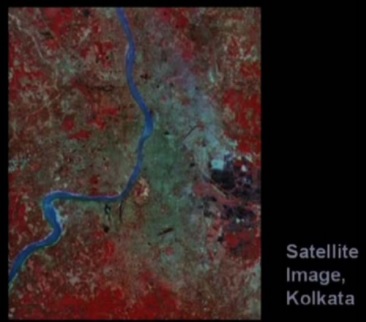
So these are various applications of these remote sensing images. Not only that, such kind of remote sensing images or aerial images can also be used for planning a city. Suppose we have to form a city, we have to build a city over a certain region, then through these aerial images what we can study is what is the nature of the region over which the city has to be built and through this, one can determine that where the residential area has to be grown, where an industrial area has to be grown, through which regions the paths have to be formed, the roads have to be constructed, where you can construct a car parking region and all those things can be planned if you have an aerial image like this.
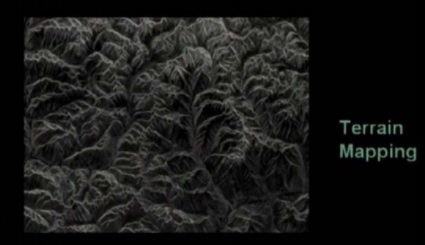
Here is another application of remote sensing images. So here you find that the remote sensing images are used for terrain mapping. So this shows the terrain map of a hilly region which is, which are not accessible very easily. So what you can do is we can get the images
through the satellite of that region which is not accessible, then process those images to find out

This is another application of remote sensing images. Here you find that this particular satellite image shows a fire that took place in Borneo. When you see that these kinds of images are useful to find out what is the extent of fire or in which direction the fire is moving.
And once you identify that, you can determine what is the loss that has been made by the wake of this fire and not only that, if we can find out the direction in which the fire is moving, we can warn the people beforehand much early so that the precautionary action can
be taken and many lives, as well as the property, can be saved.
4- Weather Forecasting
The image processing technique is also very, very important for weather forecasting. I am sure that whenever you look at the TV news on a television channel, when the weather forecasting is given, in that case, on a map some images are overlapped which tells you what is the cloud formation in certain regions. That gives you an idea that whether there is going to be some rain, there is going to be some storm and things like that. This is an image that shows the formation of a hurricane over Dennis which happened in 1990 and through this image we can find out.

what is the extent of the hurricane, what is the strength of this hurricane, and what are the precautionary measures that can be taken to save lives as well as property before and?
5- Atmospheric Study
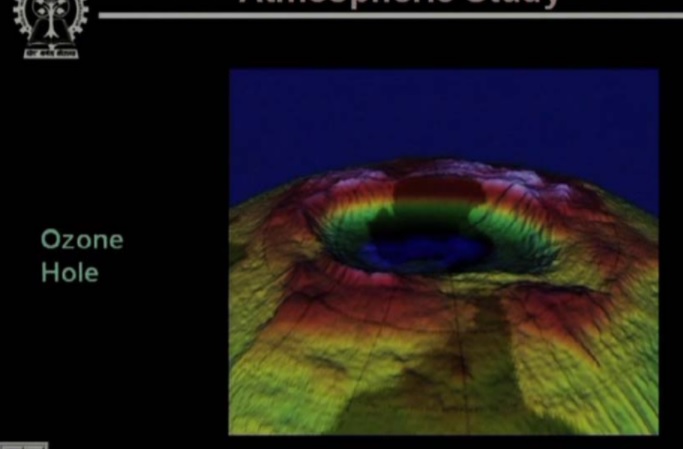
Image processing techniques are also very useful for atmospheric study. So if you look at this image, you will find that in the center part of the image what has been shown is the formation of an ozone hole. Many of you know that this ozone layer is very, very important for us because it gives us a protective layer over our atmosphere, and because of this ozone protective layer, many of the unwanted rays from the sun cannot enter our earth’s atmosphere. And by that our health is saved. Whenever there is the formation of such an ozone hole, so this indicates that all those unwanted rays can enter the earth's surface through that ozone hole. So the region over which such an ozone hole is formed, people of that region have to take some precautionary measure to protect them against such unwanted radiation. So, this is also very, very important. Such image processing techniques are very, very important for atmospheric study.
6- Astronomical Studies
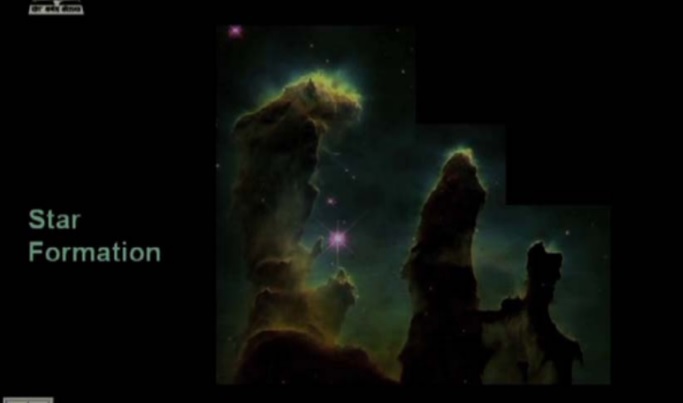
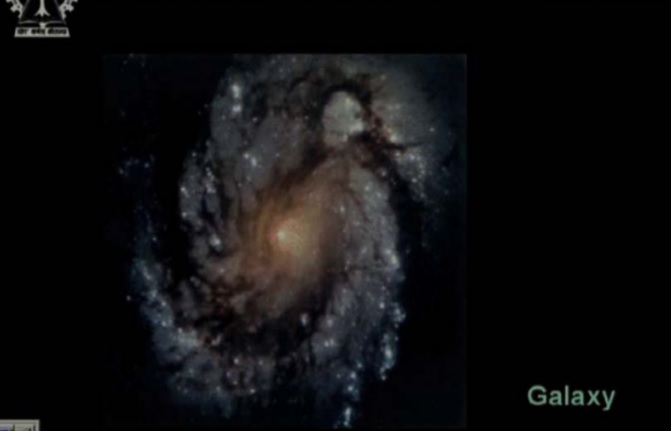
Image processing techniques are also important for astronomical studies Say for example, in this particular case, it shows the image of a star formation process. Again the next image, it shows the image of the galaxy. So you find that the application of image processing techniques is becoming unlimited. So these are applied in various fields for various purposes. Next, we come to the other domain of application of image processing techniques which is the machine vision applications. You find that all the earlier applications which we have shown; there the purpose was the visualization, the improvement of the visual quality of the image so that it becomes better for human perception.