

2-Heliograph
Here is an example of the first known photograph.
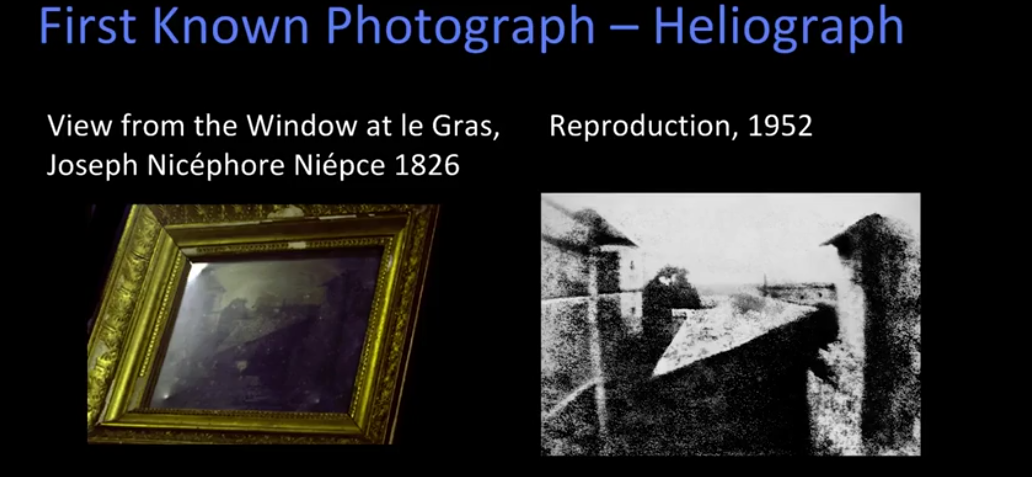
It's one of the first known recorded projections done in 1826. You can see the device here on the left, and on the right was a reproduction that was made in the mid 50s of what the image looked like. Now, what's remarkable is this image is called a Heliograph. Helio sun because it took a lot of sunlight in order to make that picture. A pewter plate, which is metal, was coated with something called Bitumen of Judea, which is some sort of derivative of a petroleum chemical. After a day long exposure, so like, eight hours, the plate's removed and the image is found by, you have to wash it in a solution, a mixture of oil of lavender and white petroleum. Which dissolved away the parts that had not been hardened by the light. So the idea was you have a chemical, it was a liquid that had underwent a chemical reaction from, from the light that would change it. So then you could then remove some of that and that's how you got an image. Those of you who've been fortunate enough ever to work in a dark room, it still has that principle of chemicals manipulating silver halide. Or, or, or some silver elements that are changed by light. Of course, most of us don't do that any more. We we use these fancy devices which have no soul, but which capture pixels better.