

8 - Impulse Train and Bed of Nails
So that's the hand wavy version about aliasing. Let's be big boys and do, and girls. Let's do this in the frequency domain.
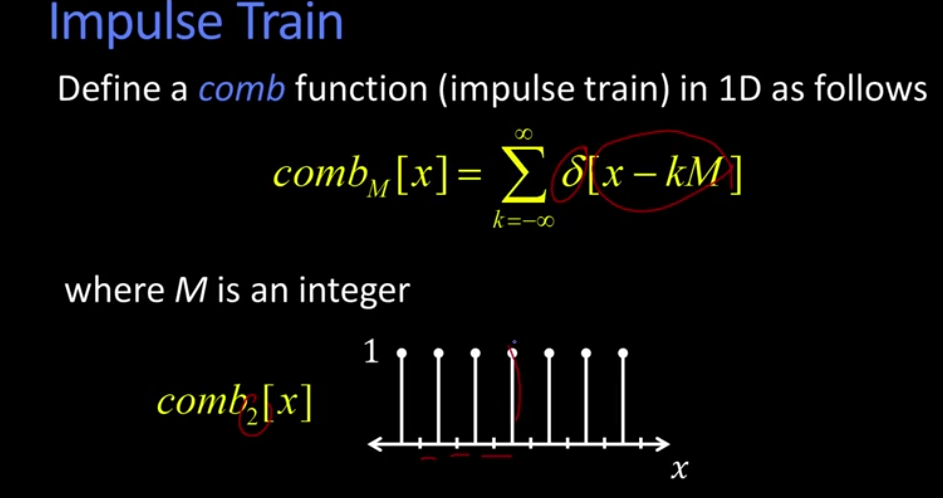
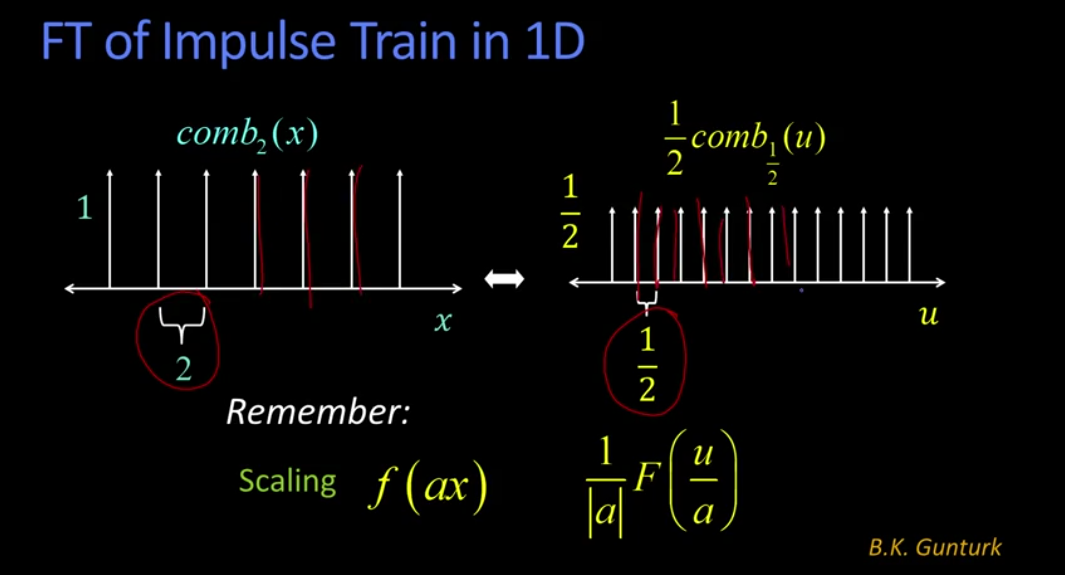
A little bit of math. The first thing we need to do is define a comb function, which is the same thing as an impulse train. So a comb function is written this. I'm not sure we've defined what this chronic or delta function is. Basically it's a function that's a pulse of one when its argument is zero and it's zero otherwise. And what this would mean here is as k goes from minus infinity to infinity this thing would count up by M's so x every M would be a one. So if this is two, then this would be a separation by twos of, of this impulse train. Okay. So if M gets bigger, my pulses get further and further apart. 'Kay, that's an impulse train. As I said before, the Fourier transform of an impulse train is another impulse train. But also as I said before, as the spacing gets larger in space it gets narrower in frequency. Remember that was the scaling property of the Fourier transform. So the less often we sample in space, the higher the samples in frequency. Okay? So that's in 1D.
We can also do impulses in 2D. And that's called a bed of nails because instead of just having a train of pulses that land on the integers or, or some multiple of integers in 1D, it's actually lying out on all the discrete coordinates in 2D which if you're in a macabre sort of mood you can think of as a bed of nails. So that's written here. Comb of M, N because we have a separation both in the x direction and in the y direction.

And also in the same way that a, the Fourier transform of an impulse train is an impulse train. The Fourier transform of a bed of nails, is another bed of nails. And again, as the nails get further apart, the Fourier ones get closer together. And you can think of it from the same reason, if I spread the nails out infinitely far away, and I get just a single pulse in the middle of the bed, I would not recommend lying down on that single nail. That would hurt but, if you think of it as an image, it's a single impulse. It would recur, it would, if you convolve that with your image, you'll get back the entire image. So you have to cover all the full plane in the Fourier space, okay? And so you have to shove all those Fourier nails back together to make a, a flat board that you could lie on.

References