

12-Field of View
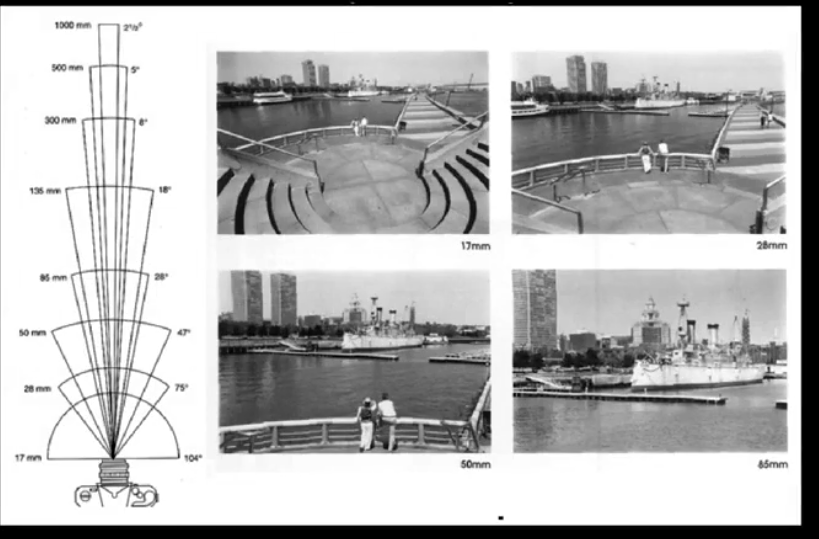
Another property of our imaging systems is field of view, sometimes called zoom, which is probably not quite right. But it's this idea of how wide of a view do we have. And I'm going to show you this in a lens that can change its focal length to show you that the field of view is a function of the focal length. There are lenses that can change their field of view while staying in constant focus are called zoom lenses. There are some lenses that you can change their focal length but you have to refocus. Those are actually called variable focal length lenses. That's the, just the nomenclature. Here we start off with a very wide angle shot, it says 17 millimeters.

And you see this little circle up there that's, that's on that boat? As we step through and we increase from 17 millimeter to 28, to 50, to 85, what we're doing is we're increasing the focal length of the lens. Here we are at 135, 300, 500, and that's 1,000 millimeters. So we've gone from a focal length of 17 millimeters to 1,000 millimeters, it's a ratio of greater than 50 to 1, and there's that guy on the boat, right. Same boat back here, all right. There he is. Okay, so that's incredible zooming. So you think they used a tripod? Well of course they did, right? In fact, this is something you might think about if you haven't thought, right? Let's assume for a moment that your hands shake just a little and they cause a small amount of angular deflection. Well if my image is looking at something this wide, then a small amount of angular deflection doesn't move my pixels very much. But suppose my angle of view is, you know, a degree or just a couple degrees. Well, then a small amount of of angular shift of my hands is going to move the pixels a lot. And that's why the longer the focal length, the more you have to stabilize your image. And that's why for really nice zoomed out lenses you have to have a tripod.
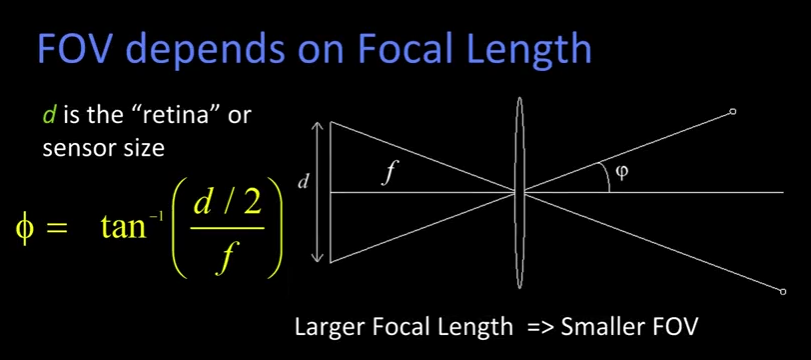
It's not just because they're heavy. It's because you need to have things be perfectly still. Now we can compute the field of view. And the field of view actually depends upon two things. One we already know, right? We know that it depends upon the focal length. But it's also going to be a function of, sort of, how big is the light sensitive element? So here calling d the size of the retina, okay? So the retina is the thing in the back of your eye that senses light. Just think of it as the light sensitive medium. So, so d is this whole size, okay. Here's f r focal length, and clearly sort of half of d over f, well, the angle who's the arctan of that, the angle that that's the tangent, that's going to be this angle phi here, which is half the field of view. So basically, the bottom line is, the longer the focal length, the smaller the field of view. The bigger the, the imaging surface, the bigger the, the field of view. In fact what's sometimes called medium format photography, instead of using tiny little sensors, they use much bigger sensors so they can put, still a lot of pixels, but over a much bigger area, that gives it much wider fields of view.