

11-Implementation Note
🔁 Understanding the scan Function in TensorFlow: How RNNs Work Under the Hood
Sections
What's the Role of scan() in Recurrent Neural Networks?
The Idea Behind scan()
Mapping scan() to RNN Components
Why Not Just Use a For Loop?
TensorFlow Example: RNN Using tf.scan()
🧠 What's the Role of scan() in Recurrent Neural Networks?
If you've been learning about Recurrent Neural Networks (RNNs) in TensorFlow, you've probably noticed there's more going on behind the scenes than just loops. One of the tools TensorFlow uses to compute RNNs efficiently—especially on GPUs—is the tf.scan() function.
But what exactly is scan, and why do we need it?
Let’s break it down.
I will now show you how to implement RNNs. I'll be talking about scan functions which are just like abstract RNNs, and they allow for faster computation. What are scan functions and how do you implement them?
🔄 The Idea Behind scan()
The scan() function in TensorFlow is like a smart for loop. It applies a given function (fn) sequentially over a list or tensor of inputs (elems), starting from an optional initializer value.
Think of it like this:
# Pseudocode for scan
output = []
state = initializer
for x in elems:
 state = fn(state, x)
 output.append(state)
return output
This structure is perfect for modeling RNNs, where you have a series of inputs (x_t) and a hidden state (h_t) that updates over time.
🧬 Mapping scan() to RNN Components
Let’s relate this to an RNN:
-
fn: The function defining how each time step updates the hidden state. Often includes a weight matrix and activation function. -
elems: The sequence of input tokens or vectors over time (i.e.,x_1, x_2, ..., x_T). -
initializer: The initial hidden state, often set to zeros (h_0).
Each time scan calls fn, it's essentially computing one time step of the RNN.
To do this, I will show you how the function scan is implemented in TensorFlow for computing the forward pass in RNNs, the scan function is designed to take a function fn and apply it to all of the elements from the beginning to the end in the list elems. Initializer is an optional variable that could be used in the first computation of fn.
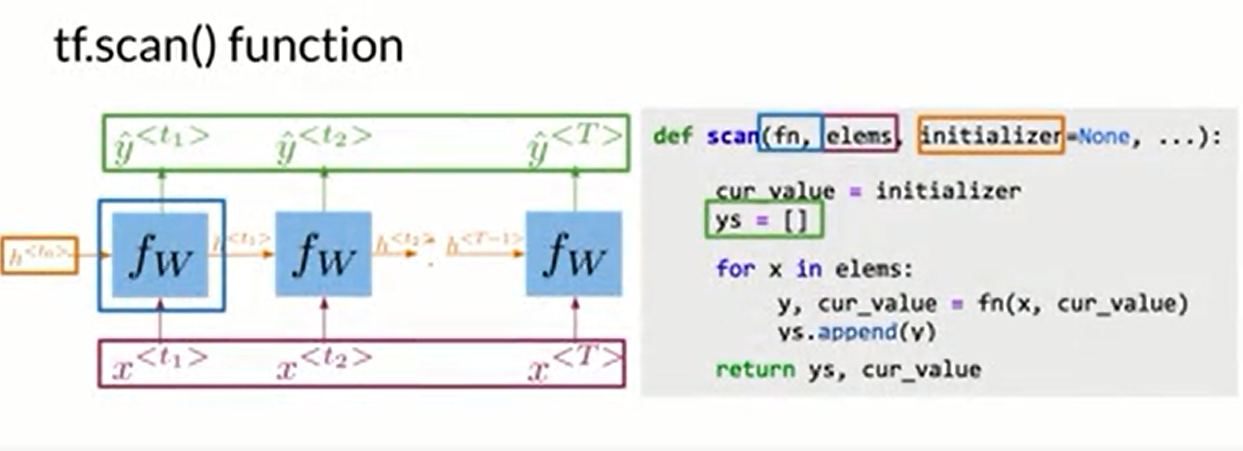
Now take this RNN, where fn is equivalent to fw, elems is the list with all the input x^t, and the initializer is the hidden state, h^t_0. The scan function first initializes the hidden state as h^t_0, and sets the ys which store the prediction values as an empty list. Then for every x in the list of elements fn is called with x and the value of the last hidden states is arguments. This for loop computes every time step of the RNN and stores the values of the prediction in hidden states. Finally, the function returns the list of predictions and the last hidden state.
⚙️ Why Not Just Use a For Loop?
You might be thinking, “Why bother with scan() if it's just a loop?”
Good question.
The answer is: parallel computation. TensorFlow’s scan enables better optimization under the hood. This abstraction lets TensorFlow schedule operations for GPUs or TPUs more efficiently than plain Python loops.
You might think this function is unnecessary because it is essentially a for loop through every time step of the RNN. However, frameworks like TensorFlow need this type of abstraction in order to perform parallel computations, and run on GPUs. I showed you how the scan function is defined in TensorFlow to mimic how RNNs work. It is important to know that these types of abstractions are needed for deep learning frameworks, because they allow them to use GPUs and compute in parallel.
👨💻 TensorFlow Example: RNN Using tf.scan()
Here’s a minimal working example of using tf.scan() to simulate a basic RNN forward pass in TensorFlow:
import tensorflow as tf
# Simulated input: 10 time steps, each with 4 features
timesteps = 10
input_dim = 4
hidden_dim = 8
x = tf.random.normal([timesteps, input_dim])
# Initial hidden state (h0)
h0 = tf.zeros([hidden_dim])
# RNN cell: simple tanh activation
W = tf.Variable(tf.random.normal([hidden_dim, hidden_dim]))
U = tf.Variable(tf.random.normal([input_dim, hidden_dim]))
b = tf.Variable(tf.zeros([hidden_dim]))
def rnn_step(prev_h, x_t):
 return tf.tanh(tf.matmul(prev_h, W) + tf.matmul(x_t, U) + b)
# Use scan to compute all time steps
all_hidden_states = tf.scan(
 fn=rnn_step,
 elems=x,
 initializer=h0
)
print("Hidden states shape:", all_hidden_states.shape)